 SHIPPING
 RETURNS
 Contact us


Tired of shaving, waxing, plucking and applying pungent depilatory creams to remove unsightly body hair? IPL hair removal is an effective long-term solution that will make you hair-free at home with minimal effort and stress. First, however, it’s important to know if an IPL hair removal device will be safe for you.
IPL Hair Removal: Is It Safe?
Using an IPL hair removal machine to remove unwanted hair is safe for most healthy people, provided that the device isn’t used on sensitive areas. For example, at-home IPL devices should never be used around the eyes, near the eyebrows or on the anus, genitalia, areolas, lips, nostrils, or ears. Men must not use the device on the face, neck and beard-growing areas or the whole genital area. They should also not be used over or near implants, subcutaneous ports, or piercings.
Our device has a sensor that ensures the light only flashes when the attachment is positioned correctly on the skin and has full contact, so no light can escape. This sometimes means that if the device is not flashing, you need to ensure the light cover is in full contact with the skin.
IPL devices are generally considered safe as they block the potentially harmful wavelengths that are below 500 nm. There are some rare side effects, but they were found to be temporary. Our device runs on the 550-1200nm wavelength range. See our full explainer on how IPL technology works for more detail.
It is not safe to use IPL if you have certain skin conditions or skin anomalies like eczema, warts, tattoos, etc. or if you are sunburnt. In addition, individuals with medical disorders and diseases such as cancer, diabetes, heart disease, vasculopathy, autoimmune disease, and photodermatoses should also avoid IPL hair removal.
In addition to the above, numerous medical treatments and drugs can make intense pulsed light unsafe, including radiation therapy, chemotherapy, painkillers, immunosuppressants, blood thinners, photosensitising meds, and skin medications. Please note that IPL is not safe for pregnant and breastfeeding women. For more info on contraindications, view the manual and consult your GP if unsure.
Common Side Effects and What to Expect
Most people experience little to no reaction. Where side effects do occur, they’re mild and temporary:
- Mild redness or warmth in the treated area for a few hours after treatment, similar to mild sunburn. This usually settles on its own.
- Slight swelling around hair follicles, particularly on more sensitive areas, which typically fades within a day.
- Temporary sensitivity to the sun in the treated area, which is why sun protection is recommended after each session.
Serious side effects like blistering or pigment changes are rare and generally linked to using the device on unsuitable skin tones, at too high a setting for a first-time area, or on skin that wasn’t properly patch tested. Always start on the lowest setting for a new area and increase gradually.
Before and After Care Tips
Before your session:
- Shave the area first so the light can reach the hair follicle rather than being absorbed by hair on the skin’s surface.
- Avoid waxing or plucking beforehand, since this removes the hair root the treatment needs to target.
- Make sure skin is clean, dry and free of lotions, deodorant or makeup.
- Do a patch test on a small area first if it’s your first time using the device.
After your session:
- Avoid direct sun exposure on the treated area for at least 24-48 hours, and use SPF if you do go outside.
- Skip hot showers, saunas and vigorous exercise for a few hours to let the skin settle.
- Moisturise with a gentle, fragrance-free product if the skin feels tight or warm.
Is IPL Hair Removal Suitable for Everyone?
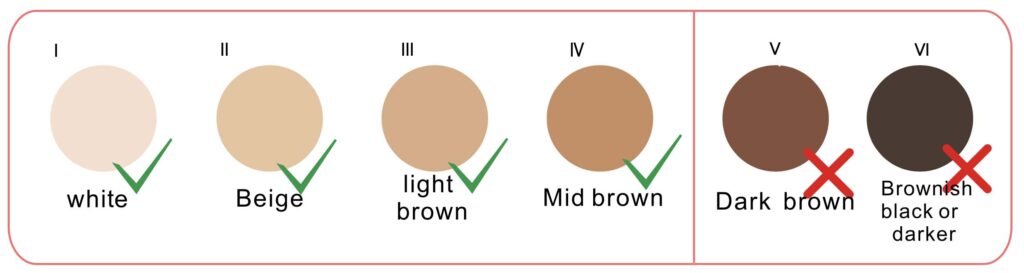
Intense pulsed light isn’t suitable for everybody. Not every skin tone and hair colour is suited to IPL hair removal. Dark brown and black skin tones, in particular, typically don’t respond well to IPL treatment. Check the skin tone table below to see if your skin type is compatible with the device.
The device is not effective for individuals with red, grey, and light blonde hair. View the hair colour chart below.
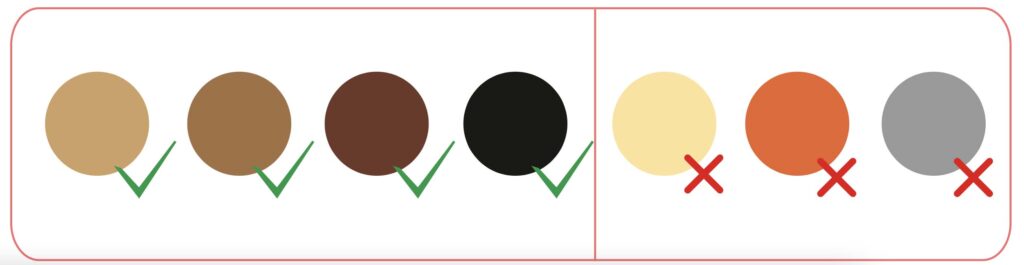
IPL technology works by targeting pigment in the hair. Thus, there should be a notable difference between your hair colour and the tone of your skin. Normally, the best and quickest results from IPL at home occur in men and women with a relatively light skin tone and dark, fine hair. However, in people with underlying conditions like PCOS and thyroid disease, IPL hair removal might take longer.
Still deciding if IPL is right for you? Read our comparison of IPL against other hair removal methods.
View our IPL hair removal device
